I was going to talk about food today. And will at some point in the future. Please write and ask questions, and I guarantee I will answer all of them. However, the accuracy of the answers is not guaranteed...
But seeing as we went shopping today, I feel a need to vent. In our lessons we always do a warm-up/get to know you section. A common questions are 'What are your hobbies?' or 'What do you do in your free-time?'(I'm trying to change that question in my students. How often do you find yourself asking those questions in conversation? If I'm unique in never using those sentences, please tell me. I'll have to reindoctrinate my students.) And a common answer is 'I go shopping.' Or 'I go to shopping,' depending on the level of the student. Now at this point I found myself wondering, shopping is a hobby? Shopping is a hobby in 90% of my students? That doesn't seem right....
However, a few days sightseeing in Osaka corrected my mistaken notion of what constitutes a hobby. In fact, I would go so far as to say that shopping is not just a hobby, but a lifestyle. Not only have I seen the biggest stores I've ever seen in my life, but I've seen more of them in one city than I ever thought possible.
To get to work Carl and I take the train. Most train stations are connected to huge overground and underground shopping networks. Not really malls because they spread out in all directions for miles on end. And for many levels up and down. Not to mention all of the separate shopping districts with covered streets and a maze of different shops. I think it would actually be possible to walk from one end of Osaka to the other without ever setting foot outside a shopping area.
For example, a walk down the street by my work goes something like this.
'Oh my God! Did you see what they had in the giant Apple store? ... No, the one across the street from Louis Vuitton. The one next to the Chanel store. ...No the other Chanel store, down the block. The one next to the Armani store. ... No the other Armani store! Aren't you paying attention?'
Or
'Oh my God! Did you see the giant United Colors of Benetton store next to the Balenciaga shop next to the Dior next to the Anna Mui next to the Calvin Klein next to the Burberry's next to the Jill Stuart next to the Ungaro next to the Givenchy next to the Ambercrombie and Finch next to the Feragamo next to the WOULD YOU LOOK AT THOSE SHOOOOESSS!!!!!!!!'
That was when I passed out from lack of oxygen. There are most of the shops we have at home plus all the ones I'd only heard of, in multiple, on the same block. It is hard to believe. Or take in all at once. I recommend going slow or risking shock. Or mountains of debt.
Speaking of shoes...
Shoes are an obsession here. I don't really want to go into fashion here. But suffice to say that Japanese women are some of the most fashion forward and fashion conscience consumers on the planet. And shoes play a big part of that. A really big part of that. I've been lusting after shoes ever since I got here.
Shoe sizes here are done in centimetres. Which is fine, I went online and did the conversion, then went shopping today to replace my poor beat up shoes. I wanted to replace them with some of the pretty, pretty, shiny shoes I see everywhere here. After finally screwing my courage up I approached the clerk and asked for my size. After some confused silence, they finally managed to tell me that the largest size they had was at least 3 cm smaller than what I wanted!!! Trips to store after store confirmed this horrifying truth. I have mutant feet. At least in Japan. And until I discover a new shopping area I will be doomed to covet, but never wear the pretty, pretty, shiny shoes.
NNNNNOOOOOOOOOOOOOOOOOO!!!!!!!!!!!!!!!!!!!!!!!!!!! (add the Shatner delivery of Khan!!, and you will get an idea of how deep my despair runs.)
On the plus side of shopping... Many men here are not afraid to embrace pink! Carl doesn't get it. But everyday we see business men with various shades of pink shirts and ties. I know that doesn't flow with the rest of this post, but Carl is truly confused and wanted me to mention it. I think it's all to get the girls. A reason that tends to explain a lot of choices made by men. :) However that doesn't explain the old man with lime green hair and a doll sticking out of the front of his pink sweater... However, fashion knows no age limits.
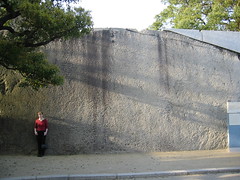
So that is Colleen in Osaka. Fashionless and shoeless. A problem I will have to solve soon. But until then look at me in my red shirt and jeans in all of our old and new photo links. Miss you all a lot, and look forward to hearing any comments or questions you may have about our blogs or Osaka.
Sunday, May 29, 2005


Saturday, May 14, 2005

Friday, May 13, 2005
The Garbageman Cometh
Still so many ideas swirling in my tiny brain that I want to share, but I have pictures to go with this one so...The Garbageman Cometh.!
One of the first things we noticed about our apartment was our garbage can...or cans. Just how complicated could trash get??? There was one large one and two smaller ones stacked on top of each other. And there were little labels with general descriptions of what went in each one and "garbage days are," but no dates were added. It's like being told there are very strict rules, punishable by electric shock, and then being told to guess what they are. Go ahead, guess...ZZAAAPPPP!! (Or maybe I was just a little stressed the first week here.)
At orientation we were eventually given the low-down on refuse in Japan. There are 3 basic types of garbage. Burnable, non-burnable and recyclable. What exactly falls into each category varies from area to area. And sometimes these categories can be sub-divided into as many as 21 different kinds trash before you can carry it to the curb.
Luckily we only had to worry about the 3 basic kinds of garbage. And we don't have to worry about a garbage day either. While the other apartments around us have obvious garbage days, as evidenced by the huge piles of garbage on the sidewalk some days, we don't. Just a garbage shack in the parking lot. Which is emptied each day. At 2:30. In the morning. Maybe I would prefer to have a garbage day.
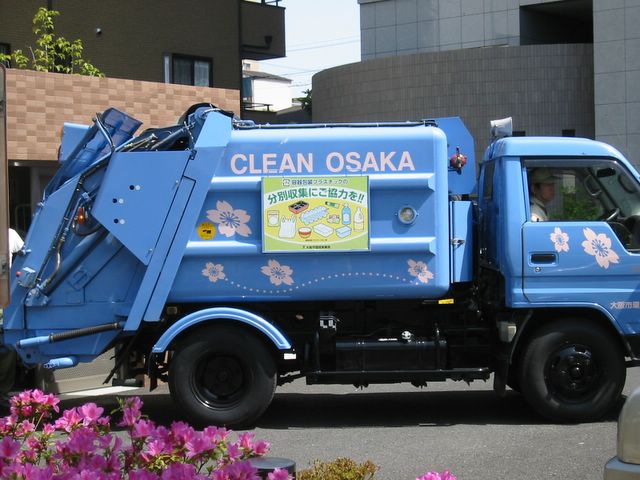
Which brings me to the subject of garbage trucks. Aren't they cute! How could you not want to keep Osaka clean with little harbingers of cleanliness like that? They also come in pink!! These tiny little trucks patrol the streets day and night, picking up garbage wherever it may be. During the day they even play music. 'The Farmer in the Dell,' or 'Camptown Races,' or any of the old familiar ice cream man songs. When I first heard it I ran from the apartment with giddy glee. 'The ice cream man! The ice cream man! The ice cr....garbageman?' The cute pink trunk could barely lift my broken heart from the curb.
Yes, these cute little pastel vehicles play ice cream truck music all day. They also carry three people when making their rounds. One to drive, and two to get out and chuck stuff in the back. Three people crammed in that little truck, full of garbage, with a jack-in-the-box tune being cranked overhead. They are either all crazy or heavily medicated. Garbagemen and women of Osaka I bow before you! You are made of stronger stuff than I. All of this so that people feel happier and more inclined to keep Osaka clean.
And Osaka needs all the help it can get. It's not that it's a dirty city. It most certainly isn't. Osaka in general is very clean. But the amount of garbage that be produced daily is staggering. Because our tourist selves haven't been to the incineration facilities (which I hear are lovely this time of year) I can only guess based on the amount of waste I see everyday.
Now every industrialized country has this problem. But the amount of packaging and gratuitous knick-knacks I see added to every purchase (in this shopping happy society) boggles my mind. Every purchase goes in a separate plastic bag. Hot items get different bags from cold items. Sometimes they're wrapped in extra tissue or plastic. Sometimes there is extra plastic or tissue inside. If you buy a bag of candy, or anything similar, everything item on the inside is individually wrapped. And then there are the collectibles that are sometimes attached as an enticement to buy, and every piece in the inside is individually wrapped as well.
I bought a drink from the 7-11, which was put in a bag. On the bottle, in a bag, there was a tiny bottle in a box. In the bottle there was yet another bag. Inside that there was a small sample of the green tea used to make the drink. Inedible and useless and time consuming (ok I'm curious so sue me).
Another addition to the garbage parade are the specially boxed gift collections of, well almost anything you would ever like to give as a gift. Chocolate, cookies, glasses, playing cards, you name it. In a flat see-through box is a wide array of said item, and each item is, you guessed it, individually wrapped. And when you buy it, it gets extra gift wrapping. All of this garbage on a tiny island with so many people, that has to be justifiably anal-retentive about where and when and how you throw your garbage out.
In conclusion, I like the collection system, but not the consumption system. However it does seem to work in this highly free market economy that only charges me 8% tax on my paycheck... ... ... I love the Garbageman!
One of the first things we noticed about our apartment was our garbage can...or cans. Just how complicated could trash get??? There was one large one and two smaller ones stacked on top of each other. And there were little labels with general descriptions of what went in each one and "garbage days are," but no dates were added. It's like being told there are very strict rules, punishable by electric shock, and then being told to guess what they are. Go ahead, guess...ZZAAAPPPP!! (Or maybe I was just a little stressed the first week here.)
At orientation we were eventually given the low-down on refuse in Japan. There are 3 basic types of garbage. Burnable, non-burnable and recyclable. What exactly falls into each category varies from area to area. And sometimes these categories can be sub-divided into as many as 21 different kinds trash before you can carry it to the curb.
Luckily we only had to worry about the 3 basic kinds of garbage. And we don't have to worry about a garbage day either. While the other apartments around us have obvious garbage days, as evidenced by the huge piles of garbage on the sidewalk some days, we don't. Just a garbage shack in the parking lot. Which is emptied each day. At 2:30. In the morning. Maybe I would prefer to have a garbage day.
Which brings me to the subject of garbage trucks. Aren't they cute! How could you not want to keep Osaka clean with little harbingers of cleanliness like that? They also come in pink!! These tiny little trucks patrol the streets day and night, picking up garbage wherever it may be. During the day they even play music. 'The Farmer in the Dell,' or 'Camptown Races,' or any of the old familiar ice cream man songs. When I first heard it I ran from the apartment with giddy glee. 'The ice cream man! The ice cream man! The ice cr....garbageman?' The cute pink trunk could barely lift my broken heart from the curb.
Yes, these cute little pastel vehicles play ice cream truck music all day. They also carry three people when making their rounds. One to drive, and two to get out and chuck stuff in the back. Three people crammed in that little truck, full of garbage, with a jack-in-the-box tune being cranked overhead. They are either all crazy or heavily medicated. Garbagemen and women of Osaka I bow before you! You are made of stronger stuff than I. All of this so that people feel happier and more inclined to keep Osaka clean.
And Osaka needs all the help it can get. It's not that it's a dirty city. It most certainly isn't. Osaka in general is very clean. But the amount of garbage that be produced daily is staggering. Because our tourist selves haven't been to the incineration facilities (which I hear are lovely this time of year) I can only guess based on the amount of waste I see everyday.
Now every industrialized country has this problem. But the amount of packaging and gratuitous knick-knacks I see added to every purchase (in this shopping happy society) boggles my mind. Every purchase goes in a separate plastic bag. Hot items get different bags from cold items. Sometimes they're wrapped in extra tissue or plastic. Sometimes there is extra plastic or tissue inside. If you buy a bag of candy, or anything similar, everything item on the inside is individually wrapped. And then there are the collectibles that are sometimes attached as an enticement to buy, and every piece in the inside is individually wrapped as well.
I bought a drink from the 7-11, which was put in a bag. On the bottle, in a bag, there was a tiny bottle in a box. In the bottle there was yet another bag. Inside that there was a small sample of the green tea used to make the drink. Inedible and useless and time consuming (ok I'm curious so sue me).
Another addition to the garbage parade are the specially boxed gift collections of, well almost anything you would ever like to give as a gift. Chocolate, cookies, glasses, playing cards, you name it. In a flat see-through box is a wide array of said item, and each item is, you guessed it, individually wrapped. And when you buy it, it gets extra gift wrapping. All of this garbage on a tiny island with so many people, that has to be justifiably anal-retentive about where and when and how you throw your garbage out.
In conclusion, I like the collection system, but not the consumption system. However it does seem to work in this highly free market economy that only charges me 8% tax on my paycheck... ... ... I love the Garbageman!
Wednesday, May 04, 2005
FAQ #3: The Bunny that Ate MY BRAIN! (aka Would you Like Fries with That?) (aka Work)
I'm sure most of you wonder 'What exactly does an English teacher do?' and 'What does Colleen do all day?' In fact, I bet it is such a perplexing question that you lay awake nights, contemplating the cosmos, begging for answers that will not come. It might even bother you to such an extent that you ponder those questions all day, every day, 'What does Colleen do?' until you cannot even focus on your own job anymore and will soon be seeking employment overseas yourselves. Well, fear no longer Gentle Reader, I am about to take you on a journey through my world.
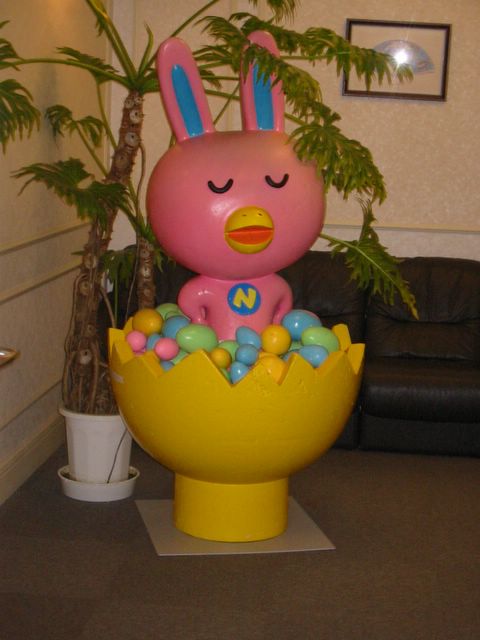
Let's start with the blog's title. The Nova usagi is pink beak-faced bunny. Every day it greets me, popping out of it's egg-filled...egg (don't ask) with an enthused grin on it's face. In a country that doesn't celebrate Easter (you try explaining Easter to a Buddhist...heck you try explaining it to a North American and see how far you get) it is an odd symbol. But this beak-faced bunny has rejuvenated the Nova image, bringing in students, and more importantly, merchandising money. The bunny is a popular character here in Japan. It's little beaked-face can be found on clocks, key-chains, lamps, and many other products that have nothing to do with learning English. Bunny toy sales brought in millions of yen, and it (the bunny) even had a Top 10 CD. The public face of the company I work for is pink, beak-faced bunny, and it's everywhere! Run for your lives people! The bunny is coming for you too!! The bunny is coming! The BUNNY IS COMING!!!
Actually, the bunny was quite popular a couple years ago, but like many animated fads it faded quickly. You can still see the bunny in many places. But most Nova ads are right now are done by a tuxedoed opera singer. But the bunny did help Nova stay on top as Japan's leader of language education. And it still greets me everyday as I go to work. Beating me into subservience with it's effulgent, effluent joy. Damn you bunny, stop eating my BRAIN!!!
Anyway, back to Nova. Nova is Japan's leader, not only in English education, but also in language education. Our office has English, Spanish, Italian, French, German and Chinese teachers teaching 22 hours a day. Nova has stayed so popular because it markets a very effective method of language education. Every lesson follows the same pattern of Assessment and Focus, Language Input, Tune-In, Listening, and Application (my trainer would be so proud). Every lesson is the same length. Every branch across Japan has a similar layout. And every lesson should be taught in the same way in every branch. Down to the minute. There are allowances for teacher creativity and tailoring the lesson to the student. But one of the big reasons that Nova is so popular is that it is similar to McDonald's method of global domination. Every burger in every chain should be the same. No customer should be surprised with the unfamiliar. And the results should be predictable every time (and I don't mean the flatulence). The assumption, of course, being that every one will learn a language very fast and very easily. And Nova certainly tries to meet that goal.
The upside to such a method is a) it is very effective, and b) I don't have to work too hard. No lesson planning, no marking tests, just simple conversation according to preset plan. My lesson planning consists of the 5 minutes before class as I go through each student's file and pick the best lesson for the group today. And my grading consists of the 5 minutes after class as I write comments about their strengths and weaknesses, and grade them on a drop down list of criteria.
The downside, of course, is that you start to feel like a cog in a giant machine. New teachers are constantly arriving to replace the ones leaving, and you feel a bit expendable. A face in the crowd. A number in a cubicle. Which, according to the computer, is exactly what you are. Language is a commodity, and you are there to serve. Just a pickle in the McDonald's-like monolith of teaching. Would you like fries with that?
Another similarity between the two corporations is well...the headset. I work in Nova's Multimedia Centre. Which means I sit in front of a computer all day and talk to students from across Japan. They get to learn from the comfort of their bedrooms, dining rooms, or utility closets. And I get to teach from the comfort of a tiny 4'x5' cubicle.
So now you're probably wondering, cubicle? how does that work? Being the generous soul I am, I shall tell you.
I arrive at work at about 2:50 pm, Monday-Thursday and Saturday. The Nova Multimedia Centre operates 22 hours a day (3-5 am is maintenance), 7 days a week. It takes over 700 employees to keep it running 22 hours a day, including tech staff, admin people, and of course teachers. There are over 500 teachers employed at this one Nova branch. As I arrive on the 15th floor I see the happy pink bunny. If you were to walk into the reception area with the bunny, your footsteps on the welcoming mat would trigger a chime in the next room, causing a Nova employee to sit in front of a computer with webcam, put on a headset and cheerily greet you. Her image would appear behind the reception desk on a monitor. Letting you, the customer, know just what a high-tech office we are.
Turning left down the hall, I swipe my way into the break room with my card key. It's shift change time so the room is crowded with people entering and leaving. Around me people from a dozen different countries are conversing in a multitude of accents and languages. People from all over Asia, the UK, North America, Australia, and Europe work here. Generally language groups tend to flock together, but almost everyone has some level of English, and then there are some multilingual savants out there too.
I walk to the rolling dividers full of time cards and punch in. Then I walk to my little shoe locker, just large enough for my headset, a notepad, my purse and my shoes. I change out of my street shoes and into my indoor slippers. Because we are a showpiece of the Nova corporation many VIP tours come through. To reduce wear and tear on the offices and to reduce the sight of any unprofessional footwear, everyone must change into indoor shoes or slippers at work. It never fails to make me feel like I'm back in kindergarten. Even though my locker has no lock on it, I leave my purse there. I check the monitors that cover one wall of the room. I check to see what booth I start my day at. My name scrolls by and I head down to the 14th floor. There are 3 teaching floors, mine is the only one with a smoking break room. The room is sealed, but it still smells like I work in an ashtray some days, especially when I get one of the lucky booths close to the break room door.
There are no cell phones, food, drink, electronic devices, or manga books allowed on work floors, to help maintain our professional look. Tours come through here often, and sometimes the cameras above us are used to transmit images of us teaching to conferences and meetings. I log onto the computer and check my schedule. I bring up my first lesson and check the student histories, comments, and recommendations from past teachers. I check to make sure I am centered in the camera, do a sound check with my mic, test my electronic whiteboard, bring up my "Colleen will be with you in a moment" opening slide (complete with my smiling face), wait for the clock to count down to 5 minutes, connect to the GingaNet (Nova internet), and wait for the chime. At exactly 3:10 pm a melodic chime sounds on every floor and over the headsets. It is in a different key and tempo on the floor and on my headset, but when they are both done, I put on my best smile and greet my first students of the day. Around me, many voices, in many languages, chime at the same time, 'Hello!'
In one quarter of my screen is the video output. There I see myself and between 1 and 3 students, sometimes 0 with the occasional no-show. Below that is the lesson plan. On the right hand side of the screen is my student comment page, which I add to throughout the lesson. I can also turn the entire screen into the whiteboard display, which I write on the desk with my electronic pen. I also have access to electronic flashcards and sound files to keep the lessons interesting. With all this technology there is bound to be a technical snafu or two. So there is also a button for tech help. That rings a bell on one side of the floor and a tech worker will run to your booth to help fix the problem. Sometimes it's on the student's end, as they have the same camera/connection GingaNet device as we do. But often it's on our end. Tech has 5 minutes to fix the problem before we have to give the student a free lesson. Often it's an easy fix. But we have to keep teaching and smiling into the camera until it is. The show must go on. And it does, for 40 minutes. Then I wrap up, thank the students, finish my comments, hit save, check my next booth number, and it's on to the next lesson.
And that's how it goes for the rest of the day. Sometimes I have the same booth a few lessons in a row, but often I move from booth to booth for each lesson. Sometimes I have free periods not filled with a lesson, but often my only break is lunch. I teach 8 lessons in a day. Then I head back up to the 15th floor. I reverse my morning routine, outside shoes and punch out. And then I'm walking back down to the train station about at about 10:45 pm.
I teach all levels of students, from the never-spoke-an-English-word-before, where I teach them how to say hello and words like shoes and tie, to the almost native speaking level, where we talk about everything from aging to Zen states. My students are all ages, have all kinds of jobs, and live all over Japan. I have taught people from Okinawa to Hokkaido and everywhere in between. Because of the huge number of students that the Multimedia centre services, I seldom have the same students twice. Sometimes I do, and I enjoy seeing their friendly faces again and getting caught up on their lives, but it doesn't really effect how I teach. The students know what to expect, and we follow the plan.
I have had some amusing lessons, but those are stories for another time. This entry was to let you know what I do with most of my time in Japan. Teaching is not my calling, but I don't dislike my job. In fact, when you get those moments when you get a student to think more about a subject then they ever have before, or when they finally understand a sentence you've been working on for 10 minutes, the joy is immediate and my job satisfaction high. Then you just hope it happens during the next 40 minutes.
I have a lot more to share with you all. Sorry this ran so long. The blogs should get shorter the longer we're here. Coming soon...'The Garbageman Cometh!' and 'Samurai Cats!'
Miss you all!
Let's start with the blog's title. The Nova usagi is pink beak-faced bunny. Every day it greets me, popping out of it's egg-filled...egg (don't ask) with an enthused grin on it's face. In a country that doesn't celebrate Easter (you try explaining Easter to a Buddhist...heck you try explaining it to a North American and see how far you get) it is an odd symbol. But this beak-faced bunny has rejuvenated the Nova image, bringing in students, and more importantly, merchandising money. The bunny is a popular character here in Japan. It's little beaked-face can be found on clocks, key-chains, lamps, and many other products that have nothing to do with learning English. Bunny toy sales brought in millions of yen, and it (the bunny) even had a Top 10 CD. The public face of the company I work for is pink, beak-faced bunny, and it's everywhere! Run for your lives people! The bunny is coming for you too!! The bunny is coming! The BUNNY IS COMING!!!
Actually, the bunny was quite popular a couple years ago, but like many animated fads it faded quickly. You can still see the bunny in many places. But most Nova ads are right now are done by a tuxedoed opera singer. But the bunny did help Nova stay on top as Japan's leader of language education. And it still greets me everyday as I go to work. Beating me into subservience with it's effulgent, effluent joy. Damn you bunny, stop eating my BRAIN!!!
Anyway, back to Nova. Nova is Japan's leader, not only in English education, but also in language education. Our office has English, Spanish, Italian, French, German and Chinese teachers teaching 22 hours a day. Nova has stayed so popular because it markets a very effective method of language education. Every lesson follows the same pattern of Assessment and Focus, Language Input, Tune-In, Listening, and Application (my trainer would be so proud). Every lesson is the same length. Every branch across Japan has a similar layout. And every lesson should be taught in the same way in every branch. Down to the minute. There are allowances for teacher creativity and tailoring the lesson to the student. But one of the big reasons that Nova is so popular is that it is similar to McDonald's method of global domination. Every burger in every chain should be the same. No customer should be surprised with the unfamiliar. And the results should be predictable every time (and I don't mean the flatulence). The assumption, of course, being that every one will learn a language very fast and very easily. And Nova certainly tries to meet that goal.
The upside to such a method is a) it is very effective, and b) I don't have to work too hard. No lesson planning, no marking tests, just simple conversation according to preset plan. My lesson planning consists of the 5 minutes before class as I go through each student's file and pick the best lesson for the group today. And my grading consists of the 5 minutes after class as I write comments about their strengths and weaknesses, and grade them on a drop down list of criteria.
The downside, of course, is that you start to feel like a cog in a giant machine. New teachers are constantly arriving to replace the ones leaving, and you feel a bit expendable. A face in the crowd. A number in a cubicle. Which, according to the computer, is exactly what you are. Language is a commodity, and you are there to serve. Just a pickle in the McDonald's-like monolith of teaching. Would you like fries with that?
Another similarity between the two corporations is well...the headset. I work in Nova's Multimedia Centre. Which means I sit in front of a computer all day and talk to students from across Japan. They get to learn from the comfort of their bedrooms, dining rooms, or utility closets. And I get to teach from the comfort of a tiny 4'x5' cubicle.
So now you're probably wondering, cubicle? how does that work? Being the generous soul I am, I shall tell you.
I arrive at work at about 2:50 pm, Monday-Thursday and Saturday. The Nova Multimedia Centre operates 22 hours a day (3-5 am is maintenance), 7 days a week. It takes over 700 employees to keep it running 22 hours a day, including tech staff, admin people, and of course teachers. There are over 500 teachers employed at this one Nova branch. As I arrive on the 15th floor I see the happy pink bunny. If you were to walk into the reception area with the bunny, your footsteps on the welcoming mat would trigger a chime in the next room, causing a Nova employee to sit in front of a computer with webcam, put on a headset and cheerily greet you. Her image would appear behind the reception desk on a monitor. Letting you, the customer, know just what a high-tech office we are.
Turning left down the hall, I swipe my way into the break room with my card key. It's shift change time so the room is crowded with people entering and leaving. Around me people from a dozen different countries are conversing in a multitude of accents and languages. People from all over Asia, the UK, North America, Australia, and Europe work here. Generally language groups tend to flock together, but almost everyone has some level of English, and then there are some multilingual savants out there too.
I walk to the rolling dividers full of time cards and punch in. Then I walk to my little shoe locker, just large enough for my headset, a notepad, my purse and my shoes. I change out of my street shoes and into my indoor slippers. Because we are a showpiece of the Nova corporation many VIP tours come through. To reduce wear and tear on the offices and to reduce the sight of any unprofessional footwear, everyone must change into indoor shoes or slippers at work. It never fails to make me feel like I'm back in kindergarten. Even though my locker has no lock on it, I leave my purse there. I check the monitors that cover one wall of the room. I check to see what booth I start my day at. My name scrolls by and I head down to the 14th floor. There are 3 teaching floors, mine is the only one with a smoking break room. The room is sealed, but it still smells like I work in an ashtray some days, especially when I get one of the lucky booths close to the break room door.
There are no cell phones, food, drink, electronic devices, or manga books allowed on work floors, to help maintain our professional look. Tours come through here often, and sometimes the cameras above us are used to transmit images of us teaching to conferences and meetings. I log onto the computer and check my schedule. I bring up my first lesson and check the student histories, comments, and recommendations from past teachers. I check to make sure I am centered in the camera, do a sound check with my mic, test my electronic whiteboard, bring up my "Colleen will be with you in a moment" opening slide (complete with my smiling face), wait for the clock to count down to 5 minutes, connect to the GingaNet (Nova internet), and wait for the chime. At exactly 3:10 pm a melodic chime sounds on every floor and over the headsets. It is in a different key and tempo on the floor and on my headset, but when they are both done, I put on my best smile and greet my first students of the day. Around me, many voices, in many languages, chime at the same time, 'Hello!'
In one quarter of my screen is the video output. There I see myself and between 1 and 3 students, sometimes 0 with the occasional no-show. Below that is the lesson plan. On the right hand side of the screen is my student comment page, which I add to throughout the lesson. I can also turn the entire screen into the whiteboard display, which I write on the desk with my electronic pen. I also have access to electronic flashcards and sound files to keep the lessons interesting. With all this technology there is bound to be a technical snafu or two. So there is also a button for tech help. That rings a bell on one side of the floor and a tech worker will run to your booth to help fix the problem. Sometimes it's on the student's end, as they have the same camera/connection GingaNet device as we do. But often it's on our end. Tech has 5 minutes to fix the problem before we have to give the student a free lesson. Often it's an easy fix. But we have to keep teaching and smiling into the camera until it is. The show must go on. And it does, for 40 minutes. Then I wrap up, thank the students, finish my comments, hit save, check my next booth number, and it's on to the next lesson.
And that's how it goes for the rest of the day. Sometimes I have the same booth a few lessons in a row, but often I move from booth to booth for each lesson. Sometimes I have free periods not filled with a lesson, but often my only break is lunch. I teach 8 lessons in a day. Then I head back up to the 15th floor. I reverse my morning routine, outside shoes and punch out. And then I'm walking back down to the train station about at about 10:45 pm.
I teach all levels of students, from the never-spoke-an-English-word-before, where I teach them how to say hello and words like shoes and tie, to the almost native speaking level, where we talk about everything from aging to Zen states. My students are all ages, have all kinds of jobs, and live all over Japan. I have taught people from Okinawa to Hokkaido and everywhere in between. Because of the huge number of students that the Multimedia centre services, I seldom have the same students twice. Sometimes I do, and I enjoy seeing their friendly faces again and getting caught up on their lives, but it doesn't really effect how I teach. The students know what to expect, and we follow the plan.
I have had some amusing lessons, but those are stories for another time. This entry was to let you know what I do with most of my time in Japan. Teaching is not my calling, but I don't dislike my job. In fact, when you get those moments when you get a student to think more about a subject then they ever have before, or when they finally understand a sentence you've been working on for 10 minutes, the joy is immediate and my job satisfaction high. Then you just hope it happens during the next 40 minutes.
I have a lot more to share with you all. Sorry this ran so long. The blogs should get shorter the longer we're here. Coming soon...'The Garbageman Cometh!' and 'Samurai Cats!'
Miss you all!
Monday, April 25, 2005
FAQ #2: Osaka
Let's get the basics out of the way...Osaka is an ancient port city located on Osaka Bay in the Sea of Japan. Rivers criss cross the city, begetting the name "The City of Bridges." Osaka City covers just 222 sq km but has over 2.6 million residents. During the work week the population swells by 1 million. It is big bustling busy city. A sea of concrete. An ocean of people. And yet...
Osaka is a friendly small town, where you would love to raise your children and make a home. It has a very low crime rate (except for bike theft), low taxes (8%), a lovely climate (average temp ranges between 6-28 degrees C, average precipitation peaks at 266 mm/month during rainy season in June and July, and then there's typhoon season...OK, maybe not a lovely climate exactly...), and green space everywhere. One thing I love about Osaka is that Osakans value their greenery with a passion that's hard to describe. They voluntarily groom public parks and playgrounds. Almost every apartment and business has a small garden tended with love and devotion. Often it is in front of the building on what passes for a sidewalk. Sidewalks are sometimes just lines painted on the edge of the narrow road. They are used for pedestrian and bicycle traffic, and growing gardens, and driving and parking cars. People don't walk much here.
(Quick note on drivers in Osaka. An excellent but aggressive group. Considering the multi-level maze of roads that grew up around the old city and the nonchalant pedestrians you have to be damn good to drive here. The conditions for getting a license are stiff. However taxi drivers still have to be blind, suicidal, and willing to STOP IN THE MIDDLE OF THE FRIGGING FOUR LANE ROAD! to get a fare.)
Osaka is best described as a cross between Vancouver (the climate, the ocean, the grey winter), Vegas (the lights! the pachinko parlours! the giant neon billboards!) and Salt Lake City (not in the Mormon way, but in the endless sea of black suits, and after you look past the concrete, the horizon is encircled by a ring of shadowy mountains). But the combination of friendly small town people and big big city is a combination hard to match on Canada. It's a city of dichotomies. The people in black suits sitting next to someone wearing every fasion trend of the eighties rolled up into one horrendously blinding outfit. The people who crouch in corners to do anything so rude as smoke or use their cellphone in public, compared with the comedians who will do anything for a laugh, including thrusting their leather hotpant clad crotches in the faces of small children to get them to stop crying (just as strange and much funnier than it sounds! (and it worked!)). There are complete opposites everywhere you look, walking side by side down the street, not just coexisting but thriving together.
I was going to write this huge long essay trying to describe Osaka (hard to believe but this was much longer before the computer ate it) but I haven't been here long enough to give anything more than a superficial portrait. I will try and break down the whys and whats I love (and ummm... dislike) about this city. Coming soon, the Bunny that Ate My Brain! (aka work).
Osaka is a friendly small town, where you would love to raise your children and make a home. It has a very low crime rate (except for bike theft), low taxes (8%), a lovely climate (average temp ranges between 6-28 degrees C, average precipitation peaks at 266 mm/month during rainy season in June and July, and then there's typhoon season...OK, maybe not a lovely climate exactly...), and green space everywhere. One thing I love about Osaka is that Osakans value their greenery with a passion that's hard to describe. They voluntarily groom public parks and playgrounds. Almost every apartment and business has a small garden tended with love and devotion. Often it is in front of the building on what passes for a sidewalk. Sidewalks are sometimes just lines painted on the edge of the narrow road. They are used for pedestrian and bicycle traffic, and growing gardens, and driving and parking cars. People don't walk much here.
(Quick note on drivers in Osaka. An excellent but aggressive group. Considering the multi-level maze of roads that grew up around the old city and the nonchalant pedestrians you have to be damn good to drive here. The conditions for getting a license are stiff. However taxi drivers still have to be blind, suicidal, and willing to STOP IN THE MIDDLE OF THE FRIGGING FOUR LANE ROAD! to get a fare.)
Osaka is best described as a cross between Vancouver (the climate, the ocean, the grey winter), Vegas (the lights! the pachinko parlours! the giant neon billboards!) and Salt Lake City (not in the Mormon way, but in the endless sea of black suits, and after you look past the concrete, the horizon is encircled by a ring of shadowy mountains). But the combination of friendly small town people and big big city is a combination hard to match on Canada. It's a city of dichotomies. The people in black suits sitting next to someone wearing every fasion trend of the eighties rolled up into one horrendously blinding outfit. The people who crouch in corners to do anything so rude as smoke or use their cellphone in public, compared with the comedians who will do anything for a laugh, including thrusting their leather hotpant clad crotches in the faces of small children to get them to stop crying (just as strange and much funnier than it sounds! (and it worked!)). There are complete opposites everywhere you look, walking side by side down the street, not just coexisting but thriving together.
I was going to write this huge long essay trying to describe Osaka (hard to believe but this was much longer before the computer ate it) but I haven't been here long enough to give anything more than a superficial portrait. I will try and break down the whys and whats I love (and ummm... dislike) about this city. Coming soon, the Bunny that Ate My Brain! (aka work).
Friday, April 15, 2005
FAQ #1: Our Apartment
I've decided to organize my first few posts around topics rather than daily events, because so much has happened since we've arrived. I've been getting a lot of questions about life here in Osaka, and I'm going to try to organize my thoughts as best as I can, but you'll have to forgive the occasional tangent. So first up, our apartment.We first arrived at our apartment around 8 in the evening. It was already dark and we wandered from the train station like lost children, following our guide, Steven from Nova, through underpasses and along narrow roads. All the while praying that the cars could see us on the side of the road. That particular path to our apartment did not come equipped with sidewalks, and we..., weren't that steady on our feet after flying for 12 hours and packing the 12 hours previous to that. Finally we rounded a corner and arrived at Joutou Green Mansion. Carl was expecting something more palatial with the name Mansion attached. But here, like home, marketing is everything.
Steven gave us a tour of our apartment, which he could do by standing in the hall. "At my left hand is your bedroom. At my right hand is your washroom. To my back is your kitchen and living room. Enjoy!" Actually, he stayed and turned on our gas, adjusted the hot water heater, and showed us the air conditioner/heater unit. Then he went to the 7-11 and got us some bottled water and batteries for the remote to our AC/heater unit and showed us how to work the thing. Then he told us about a faster and safer way to a different train station (what! no more playing in traffic!). Made sure there was nothing else we needed and left us alone for our first night in Osaka. Our first conversation in the apartment went something like this...
(stunned silence)
(exhausted silence)
Carl: 'Hey... did you notice the cemetery we passed right behind our apartment?'
Colleen: 'I was trying to ignore it...'
Carl: 'I wonder if there are any zombies?'
Colleen: 'I wouldn't know... Could we not talk about...'
Carl: 'It's just like in The Grudge with the angry spirits attacking the girl...'
Colleen: 'shut up Carl...'
Carl: 'And the elevator is just like in The Grudge too. I kept expecting to see faces glaring at us through the window...'
Colleen: 'Shut up Carl...'
Carl: 'Or like in The Eye where she sees a ghost standing in the corner of the elevator and then it slowly starts to turn around and she see that it doesn't have...'
Colleen: 'Shut. Up. Carl!!!'*
Then we laid out our futons, which were waiting for us in a small package outside the door, and I tried to sleep.
Our apartment reminds me of living in a motorhome. Narrow hallways and plastic units. Streamlined and compact. Not exactly small, just not an inch more space than is needed. We were each provided a pair of house slippers in the narrow entryway. Then there is a small step up into the hallway. On the right, you take a small step down into the bedroom. On the left you take a small step up into the bathroom. At the end of the hallway you take a small step down into the kitchen. Our kitchen contains 2 gas stove burners, a small fish broiler, a toaster oven, a plastic fridge with a crisper drawer and a freezer drawer, a small wooden table and 2 chairs. It also came equipped with 2 plates, 2 bowls, 2 mugs, 2 glasses, 2 knives, 2 forks, 2 large spoons, 2 small spoons, 1 butcher knife, 1 cutting board, 1 strainer, 1 large sauce pan, 1 small sauce pan, 1 large kettle, 1 mixing bowl, and 1 teeny tiny 1 egg frying pan. It also came with 3 garbage cans for sorting garbage, which is a story for another post.
The toilet is in it's own room. The pipe that fills the cistern comes out the top of the toilet and fills it from above. This is so you can wash your hands in the same room, saving time and water! I know of noone who actually does this, except Carl.
The shower and tub are separate, and in their own separate waterproof room. The tub is half the length of a North American tub but twice the depth. And there is no overflow drain, so you can fill it up to the rim. In traditional Japanese bathing you shower before you tub so you don't sit in your own dirt, then you rinse off again after the bath. It is very spa like and very relaxing. I turn on the hot water and it becomes my own private sauna.
The washing machine shares a room with the bathroom sink. The washing machine is cold water only. You press 2 buttons, it assesses the laundry load and adds the appropriate amount of water. It isn't that loud (despite any comparisons Carl may draw between it and things possessed). But you don't want to forget you have it on because it occasionally sounds like it's trying to talk or walk out of the room. And you really don't want to leave your cosmetics case on the machine because it could get thrown clear across the room. Not that I've ever done that, left my (or Carl's) cosmetics case on the washing machine. I blame the ghosts.
There is no dryer. In Japan, balconies are not for BBQ's and hanging out. They are for drying laundry, smoking (a lot of smoking, but again, another story), and growing plants. In fact you can annoy your neighbours quite a bit if you BBQ outside. Their clothes then smell like charcoal and meat.
Our apartment has a combination of carpet and laminate flooring except in the tatami room. Tatami mats are thick, finely woven grass mats. Quite silky and smooth. Even slippers are not often worn in tatami rooms. Apartments in Japan are measured in tatami mats, which are 3' x 6'. Each of our three rooms is 6 tatami mats, so 12' x 9'. Except we were told that Osaka mats a re a few inches smaller than in other cities, so round our square footage down a bit. Our tatami room also has the traditional sliding doors as well. We have a 14" TV/VCR unit and a worn leather loveseat. We sit there and watch TV we cannot understand, which is again another story for another post.
Our apartment also came with a small but powerful vacuum, a portable iron and ironing board, a mop and bucket, and a futon beater (not a wife beater Carl!).
So that's our apartment. This post is a little long, but I hope you have a better idea about where we live. Posts to follow soon include; 'Garbage! The schizophrenia of Japan,' 'Shopping! The hobby and the sport!,' and 'Teaching English. Would you like fries with that?.'
I miss you all, and look forward to writing to all of you soon!
Colleen
*(Any reports of Colleen telling Carl to shut up are highly fictionalized and may or may not have happened. No Carls were harmed in the production of this post. Any quotes attributed to Carl were reproduced with the full consent of Carl, whether or not he did or did not say it. Carl is a fully licensed trade name who may not be reproduced without express written consent of licenser. Carl may or may not be a fictional entity. Any resemblance to any Carl living or dead is purely coincidental.)
Steven gave us a tour of our apartment, which he could do by standing in the hall. "At my left hand is your bedroom. At my right hand is your washroom. To my back is your kitchen and living room. Enjoy!" Actually, he stayed and turned on our gas, adjusted the hot water heater, and showed us the air conditioner/heater unit. Then he went to the 7-11 and got us some bottled water and batteries for the remote to our AC/heater unit and showed us how to work the thing. Then he told us about a faster and safer way to a different train station (what! no more playing in traffic!). Made sure there was nothing else we needed and left us alone for our first night in Osaka. Our first conversation in the apartment went something like this...
(stunned silence)
(exhausted silence)
Carl: 'Hey... did you notice the cemetery we passed right behind our apartment?'
Colleen: 'I was trying to ignore it...'
Carl: 'I wonder if there are any zombies?'
Colleen: 'I wouldn't know... Could we not talk about...'
Carl: 'It's just like in The Grudge with the angry spirits attacking the girl...'
Colleen: 'shut up Carl...'
Carl: 'And the elevator is just like in The Grudge too. I kept expecting to see faces glaring at us through the window...'
Colleen: 'Shut up Carl...'
Carl: 'Or like in The Eye where she sees a ghost standing in the corner of the elevator and then it slowly starts to turn around and she see that it doesn't have...'
Colleen: 'Shut. Up. Carl!!!'*
Then we laid out our futons, which were waiting for us in a small package outside the door, and I tried to sleep.
Our apartment reminds me of living in a motorhome. Narrow hallways and plastic units. Streamlined and compact. Not exactly small, just not an inch more space than is needed. We were each provided a pair of house slippers in the narrow entryway. Then there is a small step up into the hallway. On the right, you take a small step down into the bedroom. On the left you take a small step up into the bathroom. At the end of the hallway you take a small step down into the kitchen. Our kitchen contains 2 gas stove burners, a small fish broiler, a toaster oven, a plastic fridge with a crisper drawer and a freezer drawer, a small wooden table and 2 chairs. It also came equipped with 2 plates, 2 bowls, 2 mugs, 2 glasses, 2 knives, 2 forks, 2 large spoons, 2 small spoons, 1 butcher knife, 1 cutting board, 1 strainer, 1 large sauce pan, 1 small sauce pan, 1 large kettle, 1 mixing bowl, and 1 teeny tiny 1 egg frying pan. It also came with 3 garbage cans for sorting garbage, which is a story for another post.
The toilet is in it's own room. The pipe that fills the cistern comes out the top of the toilet and fills it from above. This is so you can wash your hands in the same room, saving time and water! I know of noone who actually does this, except Carl.
The shower and tub are separate, and in their own separate waterproof room. The tub is half the length of a North American tub but twice the depth. And there is no overflow drain, so you can fill it up to the rim. In traditional Japanese bathing you shower before you tub so you don't sit in your own dirt, then you rinse off again after the bath. It is very spa like and very relaxing. I turn on the hot water and it becomes my own private sauna.
The washing machine shares a room with the bathroom sink. The washing machine is cold water only. You press 2 buttons, it assesses the laundry load and adds the appropriate amount of water. It isn't that loud (despite any comparisons Carl may draw between it and things possessed). But you don't want to forget you have it on because it occasionally sounds like it's trying to talk or walk out of the room. And you really don't want to leave your cosmetics case on the machine because it could get thrown clear across the room. Not that I've ever done that, left my (or Carl's) cosmetics case on the washing machine. I blame the ghosts.
There is no dryer. In Japan, balconies are not for BBQ's and hanging out. They are for drying laundry, smoking (a lot of smoking, but again, another story), and growing plants. In fact you can annoy your neighbours quite a bit if you BBQ outside. Their clothes then smell like charcoal and meat.
Our apartment has a combination of carpet and laminate flooring except in the tatami room. Tatami mats are thick, finely woven grass mats. Quite silky and smooth. Even slippers are not often worn in tatami rooms. Apartments in Japan are measured in tatami mats, which are 3' x 6'. Each of our three rooms is 6 tatami mats, so 12' x 9'. Except we were told that Osaka mats a re a few inches smaller than in other cities, so round our square footage down a bit. Our tatami room also has the traditional sliding doors as well. We have a 14" TV/VCR unit and a worn leather loveseat. We sit there and watch TV we cannot understand, which is again another story for another post.
Our apartment also came with a small but powerful vacuum, a portable iron and ironing board, a mop and bucket, and a futon beater (not a wife beater Carl!).
So that's our apartment. This post is a little long, but I hope you have a better idea about where we live. Posts to follow soon include; 'Garbage! The schizophrenia of Japan,' 'Shopping! The hobby and the sport!,' and 'Teaching English. Would you like fries with that?.'
I miss you all, and look forward to writing to all of you soon!
Colleen
*(Any reports of Colleen telling Carl to shut up are highly fictionalized and may or may not have happened. No Carls were harmed in the production of this post. Any quotes attributed to Carl were reproduced with the full consent of Carl, whether or not he did or did not say it. Carl is a fully licensed trade name who may not be reproduced without express written consent of licenser. Carl may or may not be a fictional entity. Any resemblance to any Carl living or dead is purely coincidental.)
Subscribe to:
Posts (Atom)